
{This post may contain affiliate links. That means that I earn a commission if you make a qualifyingpurchase through my links (such as Amazon), but it does not change the price that you pay. For more information, please see my disclaimer page.}
Emotional maturity is not something that is taught in most churches. In fact, the way the church teaches about emotions and trauma, often actually leads to stunted emotional growth and emotional immaturity.
Yet, emotional maturity is incredibly important, and how we as Christ followers are called to live.
Although emotional immaturity is incompatible with what the Bible teaches a believer’s walk should look like, it is very common in many churches today.
If you haven’t already checked out my post on Emotions and the Church, please take a minute to check it out now as this post really builds on the information shared in that post.

What Are Some Marks of Emotional Maturity?
Self Awareness/Self Reflection
A big mark of emotional maturity and one that should be addressed first is that emotionally immature people lack self awareness/reflection. How they impact others. Because of this, they don’t learn from past mistakes.
Without self awareness we cannot grow.
We are so often taught to deny ourselves, that examining ourselves gets bypassed.
Dr Lindsay C Gibson writes about emotionally immature people’s avoidance of self-reflection in her book, Disentangling From Emotionally Immature People:
“Self-justifying and often self-righteous, they rarely question themselves. They focus on their immediate needs and desires, seemingly oblivious to how they’re impacting others or even their own future. Instead of reflecting on their behavior, they get defensive and double down on their own position if someone gets upset with them.”
However, we are told often in Scripture to watch ourselves and examine ourselves and that how we treat others matters.
Bible Verses on Self-Awareness
2 Corinthians 13:5
Proverbs 20:5
Proverbs 4:23
Galatians 6:4
Matthew 7:5
Psa 51:3
Lam 3:40
1 Cor 11:27-29
2 John 1:8
Some questions for honest self reflection:
- Do I give an honest evaluation of my behavior?
- Am I able to see from other perspectives?
- Do I self reflect to identify how I impact others?
- How do I react when someone shares how my behavior impacted them?
- Do I make it about me (correcting them/explaining/flipping it back on them) or do I make space for them to share their feelings safely and validate them?
Humility
The second mark of emotional maturity that I want to address is that emotionally immature people demand attention. They often brag. They often dominate or interrupt conversations, trying to one up others. They are very self-focused.
Here’s why this is not biblical living:
Many verses talk about being humble and giving others preference. ( Philippians 2:3, 1 Peter 3:8, 1 Peter 5:5, & Romans 12:10)
Does this mean that we should never talk about what is going on in our lives? No, but we should do our best to be respectful and not interrupt others, and check our hearts to make sure that we are not being boastful and prideful.
Scripture on Humility/Pride/Boasting
Proverbs 27:2
Proverbs 11:2
Proverbs 29:23
Psa 25:9
James 4:6
Titus 3:2
1Peter 5:5
Some of Jesus’ harshest criticism was for pharisees who operated in pride. Their religious acts were boasted about.
Some questions for self reflection on the topic of bragging/attention seeking:
- Do I often steer conversations back to myself when others are the topic?
- Do I brag or do I let other’s lips praise me?
- Do I one-up others?
- Do I show active listening and empathy in conversations with others?
Emotional Maturity and Defensiveness & Avoiding Hard Conversations
Hard conversations are, well, hard, however they are where the greatest personal, and spiritual growth can happen.
Emotionally immature people become defensive and do not handle hard conversations well.
It is extremely uncomfortable for people who are not used to it. We avoid the uncomfortable in many ways, but as a result, we miss out.
Proverbs 1:5 A wise man will hear and increase in learning, And a man of understanding will acquire wise counsel
If we only ever have pleasant conversations with people, if we ignore the hard stuff or become defensive, we miss out on tremendous growth. All things considered, iron sharpening iron (Prov 27:17) isn’t comfortable, but in the end it is extremely important.
“Be willing to tolerate the discomfort necessary for growth.”
― Peter Scazzero, Emotionally Healthy Spirituality
The Bible gives several examples of hard conversations that believers should engage in:
Matt 18:15
Luke 17:3
Matt 5:23-24
Gal 6:1
Each of these conversations are hard. Confronting ungodly behavior is uncomfortable, admitting our sins or that our behavior impacted someone negatively is uncomfortable.
However we have a clear Biblical calling to accountability. The question is, are we humble enough to self reflect and learn from it?
Some questions for self reflection on defensiveness and hard conversations:
- Do I avoid the uncomfortable (emotions or conversations)?
- If someone tries to have a hard conversation with me, do I approach with curiosity/empathy or with defensiveness?
- How can I learn to better handle hard conversations?
- What are some ways that I can cultivate healthy communication and conflict-resolution skills in my relationships?
Teachability and Accountability in Emotional Maturity
A mark of a Christ follower is supposed to be humility and teachability, and it marks emotionally mature people as well.
Emotionally immature people are not very teachable/take no accountability for their behavior, often blaming others or making excuses.
“Impatience plus egocentrism means that they take things personally and blame everything on other people” Dr Lindsay C Gibson
Emotional immature people are often quite proud, not admitting when they are wrong. Or, if they do admit they are wrong, it’s often insincere and/or someone else’s fault.
Accountability for their behavior is not accepted. They are proud and defensive instead of curious or teachable.
When questioned or given correction, it is taken personally and seen as an attack. They lack the emotional maturity to separate their worth from their behavior.
Dr Lindsay C Gibson on emotionally immature people:
“EIPs jump to conclusions and easily take offense, making it extremely hard-if not impossible-to talk out problems and disagreements.”
As Christians, we are called to hold one another accountable when our behavior does not reflect well on God. That means that we need to be accountable for our behavior.
“As iron sharpens iron, we need confrontation and truth from others to grow. No one likes to hear negative things about him or herself. But in the long run it may be good for us. The Bible says that if we are wise, we will learn from it. Admonition from a friend, while it can hurt, can also help.” – Henry Cloud, Boundaries: When To Say Yes, How to Say No
Scripture on Accountability/Being Teachable
Jas 5:19-20
Jas 5:16
Matt 5:23-24
Rom 8:7
Luk 17:3
Prov 12:1
1Co 2:13-14
Prov 19:20
Prov 29:1
Prov 15:31-32
1Pe 5:5
Matt 18:15-17
Rom 12:16
Prov 26:12
1 John 1:8
Heb 12:11
Psalm 10:4
Questions for self reflection on being teachable and accountable:
- When someone offers feedback, criticism, or correction, how do I respond?
- Do I take correction or non positive feedback as a personal attack and get defensive?
- Am I able to separate my self worth from my mistake or behavior?
- Am I willing to let others correct me without getting defensive?
- Am I willing to admit when I am wrong or do not understand something?
- Do I take accountability for the impact of my actions without excuses or trying to explain it away with intent?
- Am I more interested in learning or being right in conversations?
- Do I admit when I am wrong without an excuse?
Emotionally Mature People Don’t Lie
When you can handle hard conversations and accountability and even disappointing people, there’s no need to lie.
As Christians we all know that we should not lie, but unfortunately it is commonplace for people to lie these days, Christian or not.
Despite its commonality even within the church, lying is against the Word of God
Scripture is Very Clear About Lying
Ex 20:16
Lev 19:11
Prov 12:22
Col 3:9-10
Prov 6:16-19
Ps 101:7
Eph 4:25
Matt 15:18-20
Ecc 5:2
1 Peter 3:10
Eph 4:25
Luke 16:10
Ps 34:13
Some questions for deeper thought:
- Do I lie?
- How often do I lie?
- Why do I lie? What is the purpose of the lies?
- What discomfort am I avoiding when I lie?
- What is the emotional trigger of my avoiding the truth?
- What do I fear will happen if I am completely honest?
Emotionally Mature People Can Have Deep, Meaningful Relationships
Emotionally immature people tend to keep relationships shallow because they avoid accountability and do not understand that their actions have consequences.
When someone tries to hold them accountable they shut it down, by and large keeping the relationship from becoming deeper and more meaningful.
They often gaslight and minimize other’s feelings.
They may use humor, sarcasm, or literal silence to evade vulnerability.
What the Bible says about relationships:
1 Thess 5:11
Gal 6:2
Prov 27:17
Jam 5:16
Ecc 4:9-12
Jam 5:19-20
Col 3:16
Heb 3:12-13
Rom 12:15
Some questions to reflect on emotional maturity in relationships:
(The questions on accountability also apply here)
- How deep are my relationships?
- What hard things do I avoid in relationships? Why do I avoid them?
- How does pushing people away serve to make me feel “safe” or “in control”?
- How can I do better at deepening my relationships?
- What am I afraid will happen if I am emotionally intimate with someone?
- Do I use sarcasm or humor to avoid vulnerability in relationships?
- Do I minimize others’ feelings?
- What are some ways that I can cultivate healthy communication and conflict-resolution skills in my relationships?
Emotionally Mature People Are Empathetic
It is astounding to me that empathy has been demonized in the church recently. With titles like Toxic Empathy by Allie Beth Stuckey and The Sin of Empathy by Joe Rigney (upon further research it is published by Cannon Press, a branch of Doug Wilson’s ‘church’ so it isn’t that surprising), it shows a real ignorance about what empathy actually is.
Allie Beth says “Empathy becomes toxic when it encourages you to affirm sin, validate lies, or support destructive policies.”
Validating someone’s feelings is not validating lies.
She also writes:
““But it’s a toxic empathy that pushes us not only to have compassion for someone’s difficulties but to unquestioningly affirm their feelings, because, if we were in their shoes, we’d want our feelings to be affirmed.”
Validating what someone is experiencing, offering them empathy (that sounds hard, tell me more about this, etc) is not endorsing their political choices. It is not endorsing
The definition of empathy is simply:
the ability to understand and share the feelings of another
It’s not agreeing with the feelings. It’s not saying it is right or wrong. You can understand why someone feels a certain way and hold space for their experience without agreeing with their perspective or behavior.
These books are based on the assumption that empathy and emotional validation are agreement and endorsement. They are not.
Being able to empathize is a skill that sadly the church in general today not only lacks, but loudly demonizes. It often takes being able to feel and express our own emotions to empathize with others.
As with most things, it is a good idea to look to Jesus.
When Lazarus died and He saw Mary and the people mourning him, Jesus was moved and wept. He knew that He was going to raise Lazarus, but he still mourned. (John 11:33-35) He didn’t shut them down because they were wrong. He mourned with them.
When He saw the widow mourning her son in Luke 7; 13, His heart went out to her.
Beyond the example set by Jesus, we are told in Scripture:
Gal 6:2
Romans 12:15
Luke 10:30-37
1 Cor 12:26
Some questions to explore empathy:
- Have I conflated empathy with agreement?
- What do I think empathy is and why?
- When has someone been empathetic towards me? How did that feel?
- Am I able to hold space for my own feelings so that I can hold space for the feelings of others?
- Can I see other people’s perspective or acknowledge their feelings even if I do not agree? Why or why not?
- Can I hold space for someone else’s feelings even if I do not agree? Why or why not?
- Can I be empathic instead of defensive when I do not agree with someone? Why or why not?
- How can I expand my capacity to be empathetic?
Emotionally Mature People Have a Growth Mindset
Emotionally mature people by and large have a growth mindset. They are proactive about learning and growing as a person.
The term “growth mindset” was coined by Stanford professor, Carol Dweck, in her child psychology research. In that work, she defines a growth mindset as the ability to reframe perceived failures as opportunities to learn and grow.
(Stanford)
Essentially it is an attitude of curiosity and perseverance.
Curiosity specifically is a big factor in emotional maturity as it affects empathy, self reflection, emotional regulation, being non-defensive, deep relationships, and not taking things personally.
Dr Lindsay C Gibson on emotionally immature people:
They have little curiosity for your viewpoint and feel affronted and unloved if you don’t do what they want.
In like fashion, curiosity and growth mindset go hand in hand.
In the Bible, We Are Told That Growth is a Good Thing To Strive For:
Romans 12:2
1 Peter 2:2-3
2 Peter 3:17-18
Philippians 1:6,9
1 Tim 4:15
2 Cor 5:7
James 1:2-4
Hebrews 5:12-14
Philippians 4:11-14
Act 17:10-11
Proverbs 12:1
2 Tim 3:16
Proverbs 14:29
James 1:19-20
Some Questions to Explore Growth Mindset:
- Do I avoid things that challenge me or my beliefs?
- Do I have a growth mindset?
- How can I foster a growth mindset?
- How can I be intentional about being curious?
- Do I view difficulties as opportunities to grow or as a threat?
- Do I press on in goals even if they are hard?
- How often do I use the word yet? (I don’t understand yet. I’m not good at it yet.)
- Do I believe that with effort I can improve my skills?
- Do I actively seek to grow as a person?
- Am I quick to listen and slow to speak or anger?
- Do I welcome challenges?
Emotionally Mature People Don’t Gossip
Growing up in the southern US in a heavily ‘religious’ community, gossip was big. Usually ‘disguised’ as a prayer request with a ‘bless their heart’ thrown in.
Instead of focusing on the feelings experienced by the person speaking (venting), it focuses on what another person (not present) did or private information about the person absent.
In emotionally immature people, it can be driven by need for superiority/fragile ego, avoiding accountability, desire for control, inability to directly communicate with the person they are talking about in a healthy way, lack of empathy, a need to shift focus from themselves/distract from their behavior, or a way to garner sympathy and feign vulnerability.
The Bible Has Some Strong Words About Gossip
2 Cor 2:20
James 1:26
James 4:11
Proverbs 16:28
Proverbs 18:8,21
Proverbs 20:19
Proverbs 26:20
Romans 1:29-32
Some Questions About Gossip
- When I share this, am I trying to make myself feel better, secure validation, or form alliances against someone?
- Do I seek attention, trying to feel “in the know,” or attempting to boost my own superiority?
- Is this something I would say to this person’s face? If not, what am I afraid of?
- What part of me feels insecure enough to require that I diminish someone else’s reputation?
- Am I sharing more detail than necessary when I share a ‘prayer request’?
Impulsivity and Avoidance in Emotionally Immature People
Emotionally immature people tend to do things impulsively, and avoid planning ahead for important things.
Often it is because they lack emotional regulation and delayed gratification skills, as well as not understanding the consequences of their behavior. These traits are also associated with lack of accountability. Because instant gratification is a priority, often they do not plan ahead.
Although we are told over and over in Scripture that we are to be self controlled, be sober minded, and value planning, this occasionally can be an issue.
Bible Verses on Impulsivity and Avoidance
Gal 5:22-23
Gal 5:16-17
2 Tim 1:7
Rom 8:14
1 Thess 5:6
2 Peter 1:6
Prov 14:17
Prov 25:28
Prov 21:5
Titus 1:8
1 Peter 5:8
Questions for Reflection on Self Control and Avoidance
- Do I immediately act on impulses, or do I pause and think first?
- Am I able to stay calm when I am experiencing big emotions or under pressure?
- Do I keep my voice calm during disagreements?
- Do I accept the natural consequences of my actions?
- Has there been a time when acting impulsively has caused harm to those I love?
- What are some obstacles of self-control I struggle with (e.g., lack of desire to change, thinking it’s not fun)?
- Do I think ahead and plan wisely or do I act without reflection?
- Do I prioritize instant gratification, or do I plan well for future benefits?
- How can I be more intentional about considering the future and how my behavior impacts others?
Poor Communication Skills
Another key point is that emotionally immature people often lack good communication skills because they often lack the capacity for genuine dialogue due to avoiding uncomfortable things. When we are practicing emotional maturity, we slow down, feel our feelings, and seek to communicate in healthy ways.
We are told in the Bible to specifically be ready with answers (1 Peter 3:15). We are told that a soft answer turns away wrath (Prov 15:1). We are told to let our conversations be full of grace so that we can answer everyone the way we should (Col 4:6). We are told that overall, our words should build those around us up (Eph 4:29).
We are told that life and death are in the power of the tongue (Prov 18:21), and that the religiousness of those who cannot control it is worthless (James 1:26).
Not being able to regulate our emotions often means speaking in haste. Once out there, words cannot be undone, and take a lot of work to repair.
I often tell my children that words are like hammering nails into a board. Sometimes you can remove the nail, but the mark is left on the board. With extra effort, the hole can be filled, but the board is forever changed.
Being able to effectively communicate is important to present the Gospel, but it takes working through some uncomfortable things sometimes.
One of the best resources that I have found to sharpen communication skills (and a lot of relational skills additionally) is The Next Conversation by Jefferson Fisher
More Bible Verses on Communication:
Jam 1:19
Ps 141:3
Prov 15:2
2 Tim 2:16
Prov 25:11
Prov 16:23
Matt 15:18-16
Matt 12:36
Prov 29:20
Questions to Improve Communication Skills
- How do you define communication?
- How are your communication skills?
- What do you do well when you communicate?
- What do you need to improve in your communication?
- Do you employ active listening?
- Can you control your words when you become dysregulated?
Emotional Regulation Skills
While not exactly shocking, I suppose, but a big part of emotional maturity is being able to regulate and process your emotions in a healthy way.
The more familiar you are with the feelings and sensations that accompany emotions and what triggers certain emotions in you, the better you can regulate.
In the Bible, we are not told to not be angry, but rather, in your anger, do not sin (Eph 4:26). That is why it is important to process emotions in a healthy way.
If being with us leaves other people’s nervous system on edge because they are worried about us becoming dysregulated and lashing out, that is actually a huge red flag for us.
More Bible Verses on Emotional Regulation:
Jam 1:19
Prov 25:28
Phil 4:5
Questions to Help Strengthen Emotional Regulation
- What is the specific emotion I am feeling right now?
- What is the trigger (who, what, when, where)?
- What is the feeling trying to tell me?
- How have I handled this feeling in the past? Overall, was it a healthy way to handle it?
- What does this emotion feel like in my body (e.g., tension, heat, rapid breathing, chills, heaviness…)?
- Do I allow my body to feel emotions so they can pass through me instead of suppressing them?
Emotional Maturity and Boundaries
Emotionally mature people respect boundaries because they understand that it is not rejection or a personal attack.
They do not have to have control of the situation, valuing connection with the other person over controlling the situation.
An emotionally mature ego is not so fragile that it takes someone setting boundaries personally, they understand that it is a part of a healthy relationship and respect the boundaries. They do not see it as rejection or judgement.
Emotionally immature people, however, lack self awareness and often resort to using guilt or anger to manipulate, ignoring boundaries. Because they struggle with empathy, they focus more on their needs so much that they cannot see why a boundary is needed.
However, many within the church have confused boundaries with bitterness, choosing to weaponize forgiveness while requiring no accountability for bad behavior.
If you have not already read Boundaries by Cloud and Townsend, I certainly recommend it. It is full of Scripture backed principles for setting and respecting boundaries.
God established boundaries right from the beginning, setting apart day and night, water and land. The Bible is full of the boundaries God asks us to respect in how we live our lives. Jesus even set boundaries many times.
“People with boundary problems usually have distorted attitudes about responsibility. They feel that to hold people responsible for their feelings, choices, and behaviors is mean. However, Proverbs repeatedly says that setting limits and accepting responsibility will save lives (Prov. 13:18, 24).”
― Henry Cloud, Boundaries: When To Say Yes, How to Say No
Boundaries are a “litmus test” for the quality of our relationships. Those people in our lives who can respect our boundaries will love our wills, our opinions, our separateness. Those who can’t respect our boundaries are telling us that they don’t love our nos. They only love our yeses, our compliance. “I only like it when you do what I want.” -Henry Cloud, Boundaries: When to Say Yes, How to Say No to Take Control of Your Life
“Setting limits has to do with telling the truth. The Bible clearly distinguishes between those who love truth and those who don’t. First, there is the person who welcomes your boundaries. Who accepts them. Who listens to them. Who says, “I’m glad you have a separate opinion. It makes me a better person.” This person is called wise, or righteous. The second type hates limits. Resents your difference. Tries to manipulate you into giving up your treasures. Try our “litmus test” experiment with your significant relationships. Tell them no in some area. You’ll either come out with increased intimacy—or learn that there was very little to begin with.” – Henry Cloud, Boundaries: When To Say Yes, How to Say No
Scriptures on Boundaries
Genesis 1:9-10
Prov 4:23
1 Cor 15:33
Gal 6:7
Luke 5:16
Luke 10:38-42
Questions About Boundaries
- How do I feel when someone sets a boundary in our relationship?
- How do I react when someone sets a boundary?
- What are my thoughts when someone has to set a boundary?
- Do I take boundaries personally?
- Do I respect boundaries?
- Do I blame others for the consequences of not respecting boundaries?
- Have I confused boundaries with bitterness?
- What are some boundaries that I have had to place with some people?
- Do I feel guilty for setting boundaries?
- How do I feel when I say no to a request?
Emotional Maturity and Reliability
As Christians, we should be reliable. Jesus taught that our yes should be yes and our no should be no.
When a person is emotionally immature, they often prove to be unreliable for several reasons. They are impulsive, making promises they may not feel like keeping. They avoid hard conversations, instead of saying no, they agree to something. How they feel now often over-rides promises made. They may not plan ahead to be able to keep promises. Their lack of regulation skills can keep them from being able to support others. Often, they do not see how their lack of reliability impacts others.
Bible Verse on Being Reliable
Matt 5:37
James 5:12
Questions About Reliability
- How often do I fail to keep commitments?
- Do I over commit myself? Why?
- Is my word trustworthy?
- How do I define “reliability” in my closest relationships, and how do I demonstrate it?
- Can I think of a time I broke someone’s trust? What was the root cause, and how did I make it right?
- Am I chronically late?
- Have I ever agreed to something or committed to do something to avoid an uncomfortable conversation?
- How has my capacity to be dependable changed over the last year?
- How can I work to improve my reliability?
Black or White Thinking and Emotional Maturity
All or nothing (or black and white or dichotomous thinking) thinking is an indicator of emotional immaturity. Emotionally mature people have the capacity to see nuance or grey areas.
It’s not perfect, but progress was made instead of it’s not perfect, it’s a complete failure.
Jesus was a great example of using nuance with the law. Even though the Pharisees knew the law well, they missed the heart of it, and Jesus often called this out specifically. Because He held both truth AND love simultaneously. He healed on the Sabbath. He touched an unclean leper. He spoke to women.
When people think in black or white about everything, it leads to legalism.
Scripture On Nuanced Thinking
Romans 14:2-6
1 Cor 6:12
1 Cor 10:23
Questions on Black or White Thinking
- Do I frequently use the words always or never?
- When was the last time I found myself using words like always, never, completely, or ruined?
- How might an “either/or” mindset prevent me from truly understanding someone else’s perspective?
- How rigid am I in my thinking? Can I see other perspectives?
- What two feelings are both true right now?
In Conclusion
Although I had never heard of emotional maturity until a few years ago, it has been one of the biggest areas of growth for me in those years. It is important to realize that as a whole, unfortunately, there is a lot of emotional immaturity in the church.
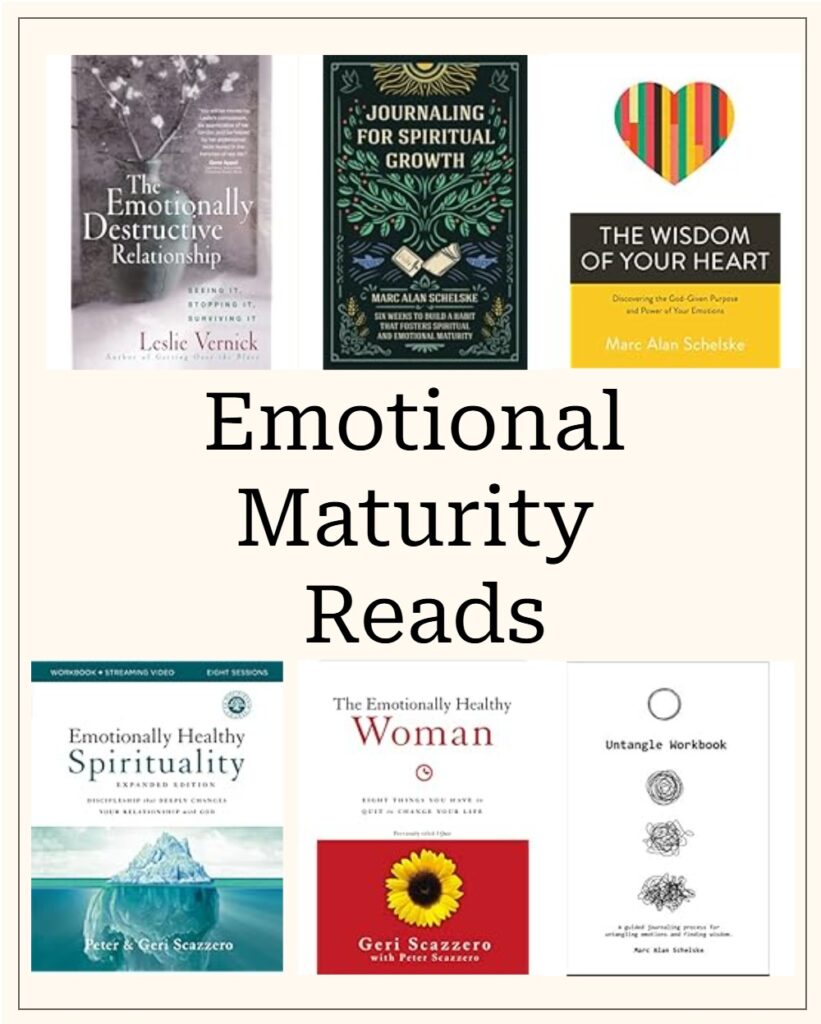
Finally, for some more resources on emotional maturity, I’d highly recommend The Emotionally Healthy Woman by Geri Scazzero and as a “what not to do” and Emotionally Destructive Relationships by Leslie Vernick and Disentangling From Emotionally Immature People by Dr Lindsay C Gibson.
Has this post challenged you in your walk with the Lord? Let me know below!


















4 thoughts on “Why Emotional Maturity Is Essential For Christians”