
{This post may contain affiliate links. That means that I earn a commission if you make a qualifyingpurchase through my links (such as Amazon), but it does not change the price that you pay. For more information, please see my disclaimer page.}
Forgiveness is important in a Christian’s walk. Unfortunately, the church has conflated forgiveness and reconciliation and twisted teachings on forgiveness to favor those who cause harm. We must do better for those who are wounded.
What Is Forgiveness and What is Forgiveness Not
It’s important to understand what forgiveness is and what it is not.
Forgiveness is about letting go of the right to revenge, releasing a debt.
It does not mean reconciliation, though it is often conflated in church.
Forgiveness doesn’t mean that you can’t put in boundaries.
It doesn’t provide instant healing.
It does not erase the consequences of behavior.
Theologian Miroslav Volf says,
“To forgive is to condemn the fault but to spare the doer.”
The AND
Being able to recognize that two things can be true at once is a sign of emotional maturity.
It’s important to know that you can forgive AND still hurt. You can forgive AND still have big feelings about the situation.
Emotions are not bad. It’s how you deal with them that can be an issue. Take time to process the emotions. Having big feelings about a situation is not a sign of unforgiveness. It is more often than not a sign of grieving the damage done to the relationship.
You may find that a licensed Christian therapist that doesn’t have a codependency model of practice and is trauma informed is needed to help you process things. Especially if there is something like betrayal trauma to work through.
If your arm is broken when someone knocks you over (intentionally or not), you still have to allow the broken arm to heal. Trauma and hurt work the same way. You can forgive AND still need to heal.
A Note on Healing
Most think of healing as a linear line. It is not. It is a lengthy process that often more closely resembles a spiral. I recently shared a reel about this, you can find it here.
Consequences
Forgiveness is important, but it doesn’t excuse bad behavior. There are consequences to all actions and inactions. Good action or inaction leads to good consequences, and ungodly behavior leads to bad consequences.
If you hammer a nail into a wall, you can remove the nail, but the mark will remain. You take away the hammer so that it doesn’t happen again. The hole must be patched.
If you touch something hot, you may regret it, but you still have to deal with the consequential burn.
Being compassionate and kind is not a blank check for others to continually drain our emotional account. It does not mean that we enable ungodly behavior by not holding people accountable. (Galatians 6:1)
Forgiveness is NOT forgetting, despite this being taught widely in churches. Those who push forgiveness as the removal of consequences of bad behavior are showing themselves to be unsafe, even if they are only ignorant.
Intent Vs Impact
It is often argued that intent matters more than impact.
They didn’t MEAN to hurt you…
While they may not have meant to hurt you, that doesn’t erase the impact.
If someone bumps you down the stair accidentally and you break your arm, does saying they didn’t mean to magically heal your broken arm? No. It still has to be dealt with and the healing process has to happen.
Emotional wounds are the same way, and intent doesn’t erase impact. Saying sorry doesn’t magically heal your broken arm either.
The AND here is you can understand they didn’t mean to AND still be hurt at the same time.
Arguing that intent is supreme minimizes the harm done, and it really is just as ridiculous as expecting ‘they didn’t mean to’ to completely heal a broken arm.
Biblical Forgiveness
Biblical forgiveness and grace is paired with the sinner’s repentance. Our reconciliation with God is always paired with repentance. Scripture consistently emphasizes that repentance is a prerequisite for receiving forgiveness.
Titus 2:11-12
Mark1:15
Rev 2:5
2 Corinthians 5:10
1 John 1:9
Acts 3:19
Luke 17:3-4
Proverbs 28:13
Matthew 3:8
Matthew 3:2
Acts 2:38
Acts 17:30
Matthew 4:17
Luke 13:3
Forgiveness means that you let go of, as in forgiving a debt. That does not mean that you lend that person money again.
It does not mean that you reconcile with that person if they are refusing to respect boundaries or allowing them to continue to hurt you.
Reconciliation After Forgiveness
Reconciliation goes beyond forgiveness; it involves restoring broken relationships. It does take forgiveness on the part of the injured party, however, the burden for change is on the offender.
If a ship is damaged in a storm, it must be repaired to return to sea. You cannot sail a ship with holes in its sails or planks. You must repair it. If someone is actively tearing the ship apart, it is especially important to put in boundaries.
To reconcile, it takes two people willing to work something out. Unfortunately it is often the injured party that has pressure applied to them to work things out, while the perpetrator’s bad behavior is enabled and excused.
Look at the example Jesus gives in Matthew:
“Therefore if you are presenting your offering at the altar, and there remember that your brother has something against 𝐲𝐨𝐮, leave your offering there before the altar and go; first be reconciled to your brother, and then come and present your offering.”
Matthew 5:23-24
In these verses, reconciliation is on the 𝙤𝙛𝙛𝙚𝙣𝙙𝙞𝙣𝙜 party, not the injured party.
Reconciliation in this verse is “diallassō” and means to change the mind of, to change thoroughly.
It is the offending party’s responsibility to change the mind of the injured party for reconciliation to happen, which comes from repentance (or turning around from the ungodly behavior) and walking out change.
When we ask others to be accountable and don’t sweep things under the rug, it is because we are offering them the chance to begin reconciliation.
“The goal of pursuit of justice must not simply be that justice happens but that reconciliation also happens.” Miroslav Volf
The Prodigal
Most of us know the story of the Prodigal son from Luke 15:11–32. It illustrates a lot of spiritual lessons.
One facet that not a lot of people focus on is how reconciliation with the father happens.
The son has left his father’s boundary lines and is doing his own thing.
It doesn’t mean that his father doesn’t love him. It doesn’t mean that his father hasn’t forgiven him. What it means is that he cannot experience the father’s love or forgiveness because he is still on his own heading away from the father.
It isn’t until the son turns from his way (repenting) and comes back to the father’s boundary that he can be reconciled with the father and experience the father’s love and forgiveness.
While we absolutely can and should release the debt, reconciliation is on the offender’s shoulders. They must repent and do the repair work necessary to rebuild what they destroyed.
Jesus on Interpersonal Forgiveness
In Scripture Jesus gives us direct instructions on forgiveness in relationships.
“If your brother sins, go and show him his fault in private; if he listens to you, you have won your brother. “But if he does not listen to you, take one or two more with you, so that BY THE MOUTH OF TWO OR THREE WITNESSES EVERY FACT MAY BE CONFIRMED. “If he refuses to listen to them, tell it to the church; and if he refuses to listen even to the church, let him be to you as a Gentile and a tax collector. ”
Matthew 18:15-17
Here Jesus tells us to call out the bad behavior and that IF he listens, you have won him.
Let’s examine what Jesus says about forgiveness. Luke 17: 3-4
“Be on your guard! If your brother sins, rebuke him; and if he repents, forgive him.
Luke 17:3-4
“And if he sins against you seven times a day, and returns to you seven times, saying, ‘I repent,’ forgive him.”
Here, again, sin is confronted and repentance is paired with forgiveness. This is the map to reconciliation that we are given in Scripture.
Weaponized Forgiveness
This is when Bible verses on forgiveness are used as a weapon against those who have been harmed. It is a ploy to swap the place of victim and offender and it often works. It is easier to tell the one broken by events to forgive than it is to face an offender or abuser.
The problem with this sort of push for forgiveness without caveat or with the implication that forgiveness is the same as reconciliation and it is the end of the matter is that it enables bad behavior by silencing the person trying to call it out.
Bonhoeffer defined “cheap grace” as “the preaching of forgiveness without requiring repentance…” that is exactly what weaponized forgiveness is. Cheap grace.
When was the last time you heard a sermon mentioning our duty to forgive? Now, when was the last time you heard a sermon telling you to repair the damage done by your actions or words? When was the last time you heard a sermon on holding one another accountable or calling out bad behavior (especially the acceptable sins)?
When we push forgiveness without making space to witness the injury, we are compounding the injustice:
“If no one remembers a misdeed or names it publicly, it remains invisible. To the observer, its victim is not a victim and its perpetrator is not a perpetrator; both are misperceived because the suffering of the one and the violence of the other go unseen. A double injustice occurs-the first when the original deed is done and the second when it disappears.” Miroslav Volf
If the church would focus more on accountability, it would definitely have more credibility, and would see wounded people return.
Being Unoffendable
This is another movement within the church that is being twisted. Instead of promoting true peace, accountability, and reconciliation, this ideal is often twisted into a tool for spiritual bypassing, enabling toxic behavior, and silencing those harmed.
It shifts the responsibility, guilt, and shame from the offender to the person who was injured, compounding the original wound.
This movement is normalizing the tolerance of harm, offers a breeding ground for abuse and manipulation, erodes healthy boundaries, and encourages emotional detachment/disassociation.
Spiritual Bypassing and Minimization
Ignoring the emotions God designed you with. “You shouldn’t be angry, you should be unoffendable.” Anger, sadness, and grief are often a signal that a line has been crossed and there’s a need for a boundary. It can point us to things which need closer examination. It can signal that there is healing that needs to happen.
Yes, anger and conflict are uncomfortable, however the inability of people to handle them in healthy ways is only being enabled here. Growth that would come through working things out is stunted.
“We’re all sinners” is a line that many jump to without even truly hearing or dealing with the pain shared with us. This is minimizing the harm done.
We don’t have to compare our experienced pain to another’s pain and their forgiveness to measure if we should feel hurt. Many often point to Elisabeth Elliot or Corry TenBoom as examples of forgiveness and if they can forgive, you should too or why can’t you? This is minimization and is incredibly harmful, often causing secondary trauma.
Just because someone else went through something hard, doesn’t make our experience less hard. It doesn’t erase the harm done. It doesn’t instantly heal the wounds, and pressure to do so is unhealthy.
Silencing Those Who Were Harmed
Enabling Toxic Behavior
Instead of the anger being felt calling us to examine the offender, we push forgiveness or being unoffendable on the person harmed. No accountability for the toxic behavior. Calling it out would mean that we’ve been offended (and Jesus himself told us to rebuke those who harm us).
You hear sermons on being unoffendable, but when was the last time you heard a sermon on healthy conflict resolution? On being unOFFENSIVE? When did you last hear it preached that you need to repent and repair with those you have hurt?
Instead of empathy or emotional validation, those who bring a hurt to someone with this mindset are met with being told it’s their fault for being offended.
Instead of doing the hard work of actual reconciliation and repentance, the church may demand that people just “get over it” to maintain a superficial atmosphere of pseudo-mutuality.
People may smile, agree, and perform acts of care, but there is no genuine emotional connection or vulnerability.
Real disagreements or emotional pain are avoided or suppressed to maintain the illusion of unity.
Jesus overturned tables, named corruption, and sharply rebuked religious hypocrites.
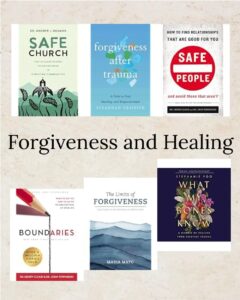
The popular book Forgiving What You Can’t Forget by Lysa Terkeurst is a perfect example of this emotional bypassing, minimization, and weaponized forgiveness without accountability.
Accountability
The Bible also tells us if people claiming the name of Christ are unrepentant in ungodly behavior to treat them as you would treat tax collectors in that culture and turn away from them (Titus 3:10, Matthew 18).
Furthermore we are told to make sure that the company that we keep is godly
1 Corinthians 15:33
Proverbs 1:8-19
Proverbs 6:16-19
Proverbs 13:20
2 Corinthians 6:14
Titus 3:10
1 Corinthians 5:11-13
1 Timothy 6:5
Matthew 7:6
2 Timothy 3:5
Ephesians 5:11
2 Thessalonians 3:6
Psalms 1:1
2 John 1:10-11
Boundaries are Not Bitterness
Unfortunately, another thing that the church has conflated is that boundaries=bitterness or unforgiveness. This is not true.
“Many people are too quick to trust someone in the name of forgiveness and not make sure that the other is producing “fruit in keeping with repentance” (Luke 3:8). To continue to open yourself up emotionally to an abusive or addicted person without seeing true change is foolish. Forgive, but guard your heart until you see sustained change.”-Henry Cloud, Boundaries: When To Say Yes, How to Say No
“Forgiveness and opening up to more abuse are not the same thing. Forgiveness has to do with the past. Reconciliation and boundaries have to do with the future. Limits guard my property until someone has repented and can be trusted to visit again. And if they sin, I will forgive again, seventy times seven. But I want to be around people who honestly fail me, not dishonestly deny that they have hurt me and have no intent to do better.”
― Henry Cloud, Boundaries: When to Say Yes, How to Say No to Take Control of Your Life
Having big emotions about an event doesn’t indicate bitterness either. The Bible is full of examples of deep grief and lament. Remember the AND. We can forgive AND have big emotions.
More Resources
Conclusion
Yes, forgiveness IS important, but it is equally important to understand what forgiveness is and what it is not when embarking on our healing journey, as well as being able to spot those who are pushing an unhealthy and unsafe view of forgiveness.

Have you ever faced some of these unhealthy views of forgiveness?